.png)

You're Not Losing the Plot. You're Just Having a Flush.
As a nurse, I've learned that the biggest moments in a woman's life aren't always the ones anyone notices. Childbirth gets a card. A hot flush gets nothing — just her, fanning herself with whatever's to hand, insisting she's "just got a bit warm."
I know this one from both sides of the desk. I've sat with women going through it. And I've been that woman myself — could have been anywhere, really: the supermarket queue, a meeting, an ordinary Tuesday.
You'll know the feeling if you've had it. It doesn't knock first. One second you're fine, the next there's a heat rising up through your chest and neck like someone's turned up a dial that only you can feel. Your heart picks up pace for no reason you can point to. Your face goes red whether you like it or not. You're suddenly aware of every layer of clothing you're wearing and how quickly you could get out of them without causing a scene. And underneath all that — the scanning: is anyone looking, do I say something, how long does this one last. Then, as quickly as it arrived, it's gone, and you're left slightly clammy and a bit rattled, wondering when the next one's due.
Here's the bit nobody mentions: it's rarely just the flush. Turns out my brain panics before my body even gets the memo — that bracing, not now, not here, winds the whole thing tighter. The flush triggers the thought. The thought fuels the flush. Round it goes.
You can step off that particular merry-go-round. Not by willing the flush away, but by changing how your mind and body answer it.
That's not a wellness slogan — it's a specific, evidence-based approach developed by Professor Myra Hunter and Dr Melanie Smith at King's College London, tested through randomised controlled trials, and recommended by the National Institute for Health and Care Excellence (NICE) for hot flushes and night sweats. I trained in it through the British Menopause Society, and I deliver it as In Her Prime.
It isn't a fallback for women who "can't do HRT." It works alongside HRT just as readily as it works without it and it leaves you with skills that are yours for good.
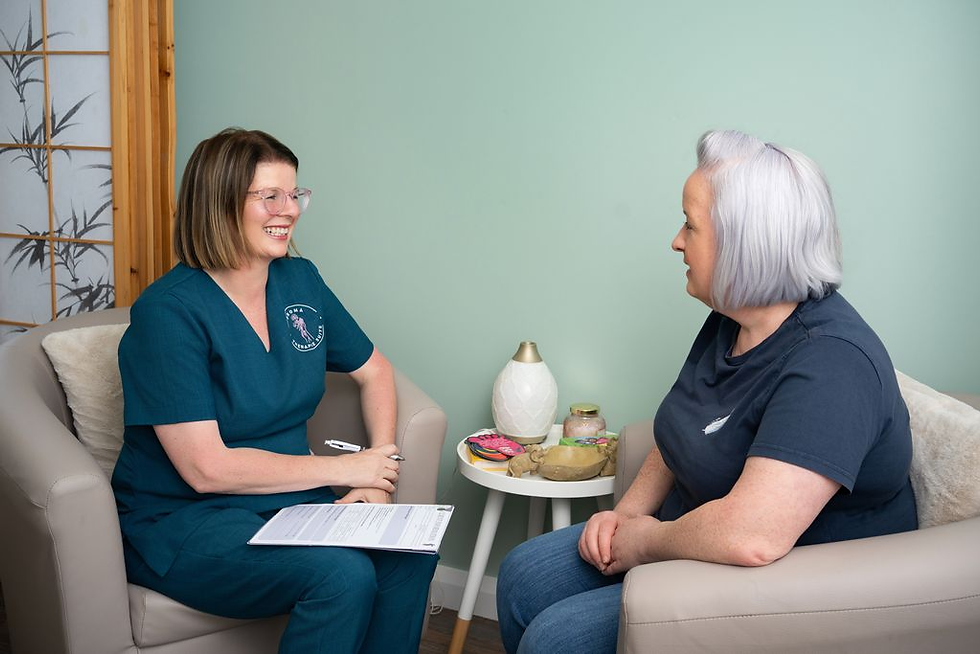
Across a small number of sessions, I walk women through what's actually happening in the body during a flush, practical tools for the moment it hits, ways to work with disrupted sleep rather than against it, and an individual plan — because no two women's menopause looks quite the same.
Whether you're peri- or postmenopausal, on HRT or not, or managing symptoms after breast cancer treatment, this may be worth ten minutes of your time. It isn't a substitute for your GP — if you've concerns about your symptoms or treatment, that's still your first call. This sits alongside that care, not in place of it.
We're told our prime is something behind us — that window somewhere in our twenties or thirties, already closing by the time we're old enough to know what to do with it. And by the time menopause arrives, the message gets even louder: you're past it now, manage quietly, don't make a fuss.
But here's what I think, and what my own perimenopause confirmed from the inside: the woman in the mirror isn't past her prime. I am wiser, less apologetic, finally clear on what I will and won't carry anymore. What I was missing isn't vitality. It's permission — and I'm not the only one.
And that's the real observation, the one that still catches me: women will rearrange their whole lives around everyone else's comfort and call it love, call it duty, call it just what you do — while quietly shelving their own sleep, their own health, their own peace, as if those were optional extras rather than the foundation everything else stands on. It isn't a virtue. It's a habit. And habits can be unlearned.
This is why the programme isn't just about managing hot flushes and night sweats — though it does that, properly, with the evidence behind it. It's about handing a woman back the idea that midlife isn't a decline to be managed. It's a prime to be claimed. Hers.
If you're curious, I offer a paid, 45-minute initial menopause support consultation — we look at what you're experiencing, whether In Her Prime fits, and where to point you if it doesn't.
Fiona Brown is a Registered Nurse with over 30 years of clinical experience and specialist training in CBT for menopausal symptoms through the British Menopause Society. She is the founder of Aroma Therapie Suite, a nurse-led women's health and wellbeing practice based in Dungannon, County Tyrone.
The information in this article is for general educational purposes and is not a substitute for individual medical advice. If you have concerns about your symptoms, please speak to your GP. As with any therapeutic approach, individual experiences and outcomes vary.


Comments